

Image 1: With hemorrhage washed away, lacerations are seen radiating from a point roughly localized in the inferior border of the right lobe of the liver.
Question: What sequelae are our patient most at risk for in the immediate period following this liver injury?
Question: Generally, how at risk is the liver to traumatic abdominal injury?
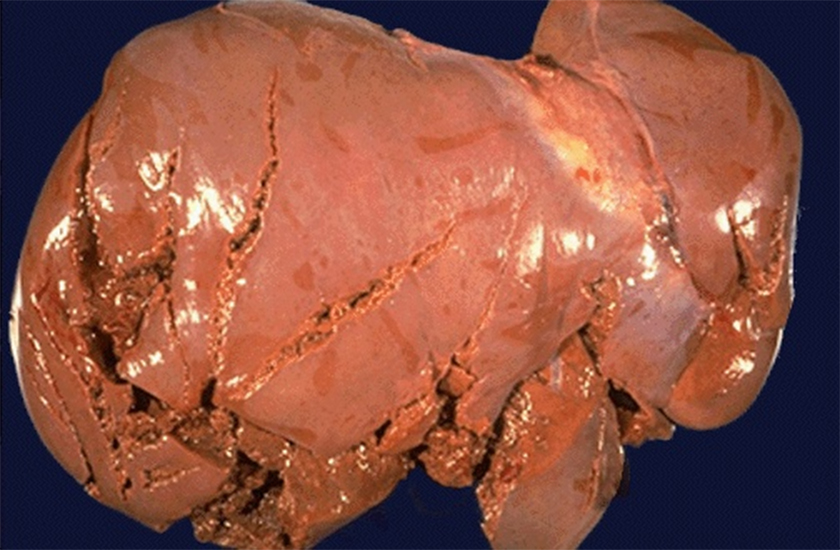
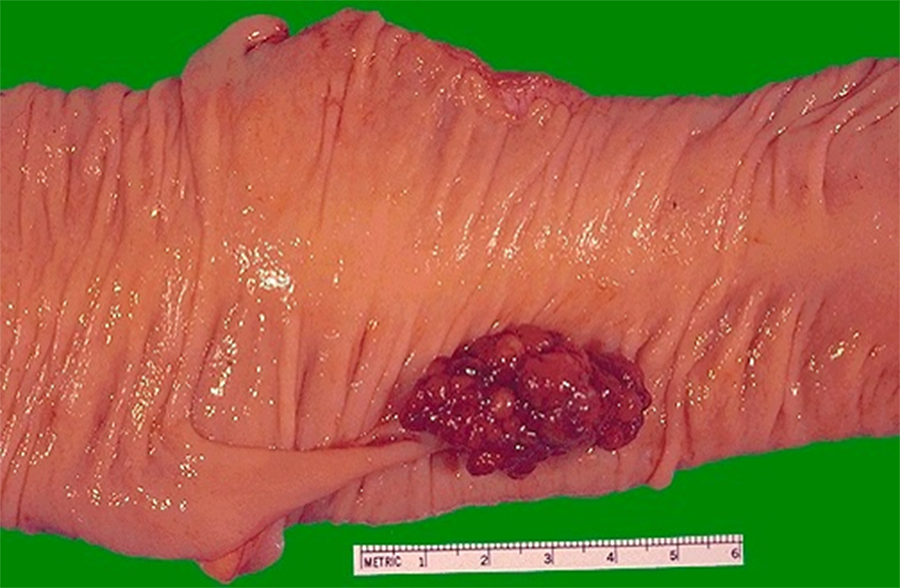
Image 2: A 3.5 cm mass was found in the descending colon upon longitudinally opening the bowel. The mass is typical of a pedunculated adenomatous polyp. The smooth, bosselated, cerebriform surface is hemorrhagic, and the mass is attached to the mucosal aspect by a stalk (peduncle). Colon polyps can also be grossly sessile, defined by the absence of a stalk and with the lesion appearing to sit directly on the mucosal surface.
Question: What gross qualities of this adenomatous polyp make it amenable to clinical surveillance?
Question: Contrast the gross features of this polyp that suggest it may be either benign or malignant?
Video 1:
Question: Starting at 1:35 min, could our patient's colon polyp in Image 2 be removed by the biopsy forceps that are shown? If not, what may be done from a management perspective for our patient?
Question: Starting at 3:29 min, how does the growth pattern of the doctor’s polyp contrast with the polyp seen above in our patient? Compare the ramifications for potential invasion in these different polyps.
Image 3 (virtual): This slide is a representative section through the adenomatous colon polyp. On the right is a strip of normal colonic mucosa and superficial submucosa that transitions into the adenomatous polyp. At this low power, the pedunculated nature of the polyp is obvious, and the stalk is evident as a portion of submucosa that has been 'pulled up' into the expanding, mucosally-oriented neoplasm. Even at this power, glandular shapes formed by the neoplasm can be seen as more elongated and complex, and the glandular proliferation is more hyperchromatic than the epithelium that surrounds it.
At high power, the glandular proliferation is replacing the mucosal surface, and the lamina propria appears less prominent as the neoplastic glands become crowded in some fields. Focus on a high power view of the neoplastic proliferation adjacent to normal colonic glands. While Goblet cells and absorptive cells are readily apparent in the normal field, these specializations appear lost in the neoplastic proliferation. The neoplastic glands show nuclear hyperchromasia with coarse chromatin, cellular stratification (the cells appear to 'pile up' on one another), and increased mitotic activity, including at the luminal surface. These features of dysplasia define an adenomatous polyp and indicate that the acquisition of mutations has occurred over time.
Now, using medium and high magnification, examine the distal-most stalk, which is the area at the base of the polyp. Examine the muscularis mucosae deep to the normal mucosa on either side of the polyp. Follow the muscularis mucosae from one normal side as it tracks toward the neoplastic proliferation. Note that, at points on either side of the stalk, the muscularis mucosae is no longer apparent. In these locations, neoplastic glands have extended through the muscularis mucosae. On the left side of the stalk, neoplastic glands are found directly under the intact muscularis mucosae, and are also in continuity with the primary neoplastic proliferation.
Question: What process is occurring in this neoplastic polyp at its base?
Question: What is your definitive diagnosis for the collective pathology on this slide?
Click on this link to view normal Digestive System 1 histology.
Click on this link to view normal Digestive System 2 histology.