
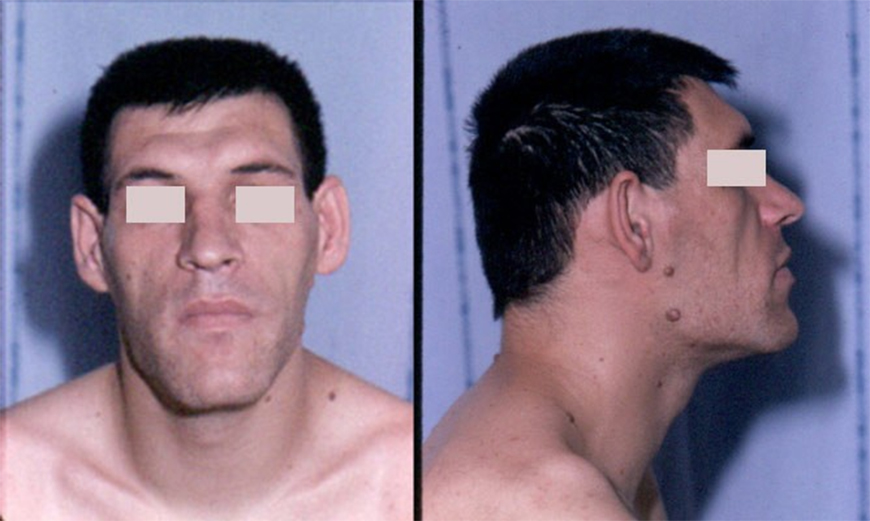
Image 1: These front and side view images of the patient (when alive) were included with the autopsy paperwork and were secured by the forensic specialist assigned to the case. Overall, coarsening of facial features is present, including slightly prominent cheekbones and increased facial (skin) markings. Frontal bossing (pronounced protrusion) of the brow and prognathism (pronounced protrusion) of the jaw are also noted. Hyperpigmented papules are evident on the face and neck.
Question: Does this patient appear to be his stated age?
doi:10.1186/1750-1172-3-17, CC BY 2.0, https://commons.wikimedia.org/
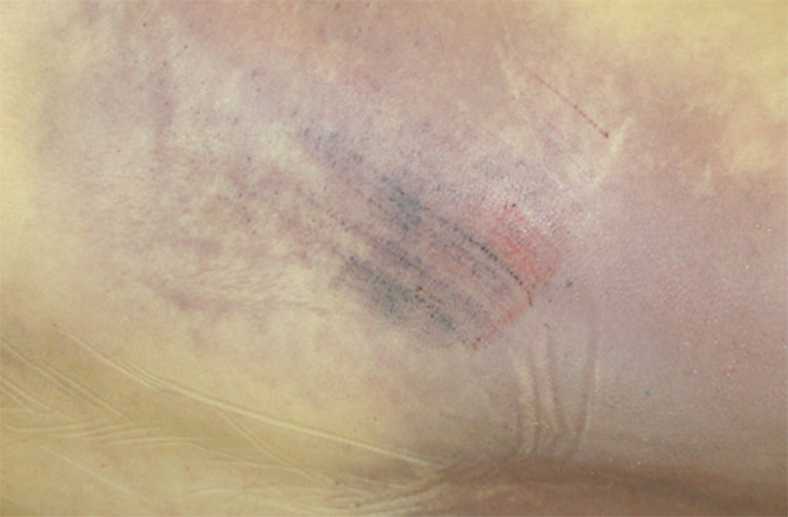
Image 2: This image is from the patient's flank. An abrasion is overlying a contusion, with the former involving injury largely to the epidermis, and the latter involving injury to the dermis and subcutis. An abrasion is formed when some type of lateral or tangential action by an injurious agent impacts the skin, and damage is largely limited to the epidermis (with minimal injury to the superficial dermis). Contusions necessarily involve damage to capillaries or small vessels, and then tracking of hemorrhage along tissue fascial planes.
Question: What dynamics of injury development can be discerned from an abrasion?
Question: Is a contusion most prominent at a site of impact?
Question: Generally, how 'old' is the contusion in this image?